
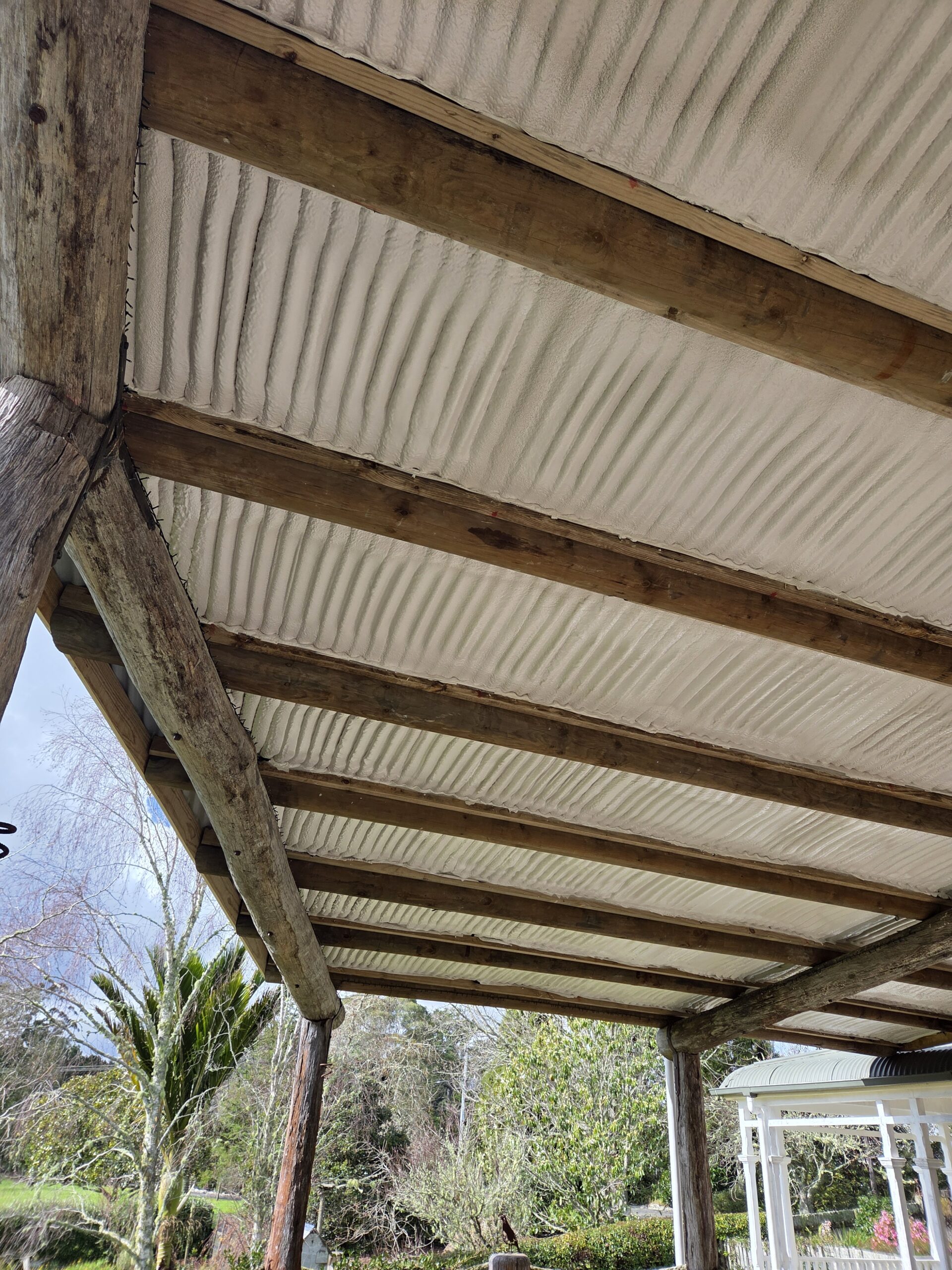
Closed-Cell Spray Foam Insulation
Continuous insulation, air control and moisture resistance in one compact system
Closed-cell spray foam bonds directly to suitable surfaces and forms a dense insulation layer without joints or gaps. It can be used in buildings, containers and specialist agricultural, marine and industrial applications where space, condensation or exposure make conventional insulation difficult.
A high-performance option when space and moisture control matter
The foam expands during application, follows the shape of the substrate and cures into a rigid closed-cell layer. Because the insulation is continuous, it also limits uncontrolled air movement through gaps and junctions.
Thermal performance
Closed-cell foam provides strong insulation performance in a relatively thin layer, making it useful where cavity depth or internal space is limited.
Continuous air seal
Spraying directly to the prepared surface creates an insulation layer without the joints and cut edges found in sheet or batt systems.
Moisture resistance
The closed-cell structure resists water absorption and can help control condensation when the complete building or enclosure design is considered properly.
Where closed-cell spray foam can be used
Closed-cell foam is particularly useful on steel, timber, concrete and ply where a continuous insulation layer needs to follow complex shapes or fit within restricted space.
Homes and buildings
Roofs, walls and suspended timber floors in new builds or suitable retrofit work, including difficult junctions where draught control matters.
Containers and transportable structures
Applied directly to prepared steel to reduce heat transfer and manage condensation while retaining as much internal space as possible.
Specialist applications
Commercial, agricultural, marine and industrial spaces where temperature stability, moisture resistance or irregular construction requires a tailored approach.
Specified for the actual construction
Foam type and thickness should be selected for the substrate, climate zone, required thermal performance and the way the space will be used. More thickness is not automatically the right answer if moisture, ventilation and lining details have not been resolved.
- Typical building areas include roofs, walls and suspended floors
- Suitable for selected steel, timber, concrete and ply substrates
- Useful in thin cavities where higher performance is required
- Application thickness and substrate condition are checked during planning
Thermal values: the CodeMark-certified closed-cell product currently used by LJ Solutions is specified at RSI 1.1 per 25 mm. Final thickness and compliance requirements must be confirmed for the selected product and project.
Insulation, moisture and ventilation need to work as a system
Closed-cell foam can act as an effective air and vapour-control layer, but it should not be treated as a reason to ignore the rest of the construction. Wraps, cavities, drainage paths, linings and ventilation all depend on the project design.
Wraps and ventilation cavities
Some assemblies can be sprayed directly to the substrate. Others require a drainage, service or ventilated cavity. We review the intended build-up before application rather than applying one rule to every project.
Healthy indoor ventilation
Air sealing reduces uncontrolled leakage. Occupied buildings still need deliberate fresh-air and moisture removal through suitable passive or mechanical ventilation.
What happens before the foam is sprayed
Good preparation and access are essential. The exact sequence varies, but most projects follow the same practical stages.
Review the project
We confirm the substrate, access, intended use, required performance and any areas that must remain clear.
Prepare the area
Services should be at the agreed stage. Surfaces must be suitable, dry enough and accessible, with nearby areas protected from overspray.
Apply the system
Two components are heated, proportioned and sprayed by trained installers. The foam expands and cures rapidly against the surface.
Inspect and finish
Coverage and thickness are checked, excess foam is trimmed where required and the area is prepared for the following trade or lining.
Closed-cell spray foam questions
Is this the foam injected through holes in existing walls?
No. That is normally an injection-foam process. Spray foam is applied to an exposed surface, allowing the installer to see the substrate, coverage and finished application.
Does closed-cell foam always replace building wrap?
No single answer suits every construction. Closed-cell foam can provide air and vapour control, but wraps, drainage layers and ventilated cavities may still be required by the project design or consent documentation.
Does an airtight building still need ventilation?
Yes. Airtightness limits uncontrolled leakage; ventilation provides controlled fresh air and moisture removal. Extract fans, passive vents or mechanical ventilation may form part of the overall design.
How does closed-cell compare with open-cell foam?
Closed-cell foam is denser, more moisture resistant and generally provides more insulation at the same thickness. Open-cell foam is lighter and can suit internal areas where expansion, acoustic performance or cost are stronger priorities. Product choice depends on the application.
How thick does the foam need to be?
Thickness depends on the required RSI value, climate zone, construction and available space. We confirm the target before quoting rather than relying on a single standard thickness for every project.
What to send us
A few useful details allow us to assess whether closed-cell spray foam is suitable and price the right scope.
- Site location
- Building or structure type
- Approximate areas and dimensions
- Substrate material
- Photos of the areas
- Access and height
- Required performance or thickness
- Project timing
Need to know whether closed-cell foam suits the project?
Send us the location, dimensions and a few clear photos. We can identify what else is needed before preparing a quote.